As Uzbekistan expands solar and wind generation, Battery Energy Storage Systems (BESS) can help balance supply and demand, shift energy into evening hours and increase grid flexibility.
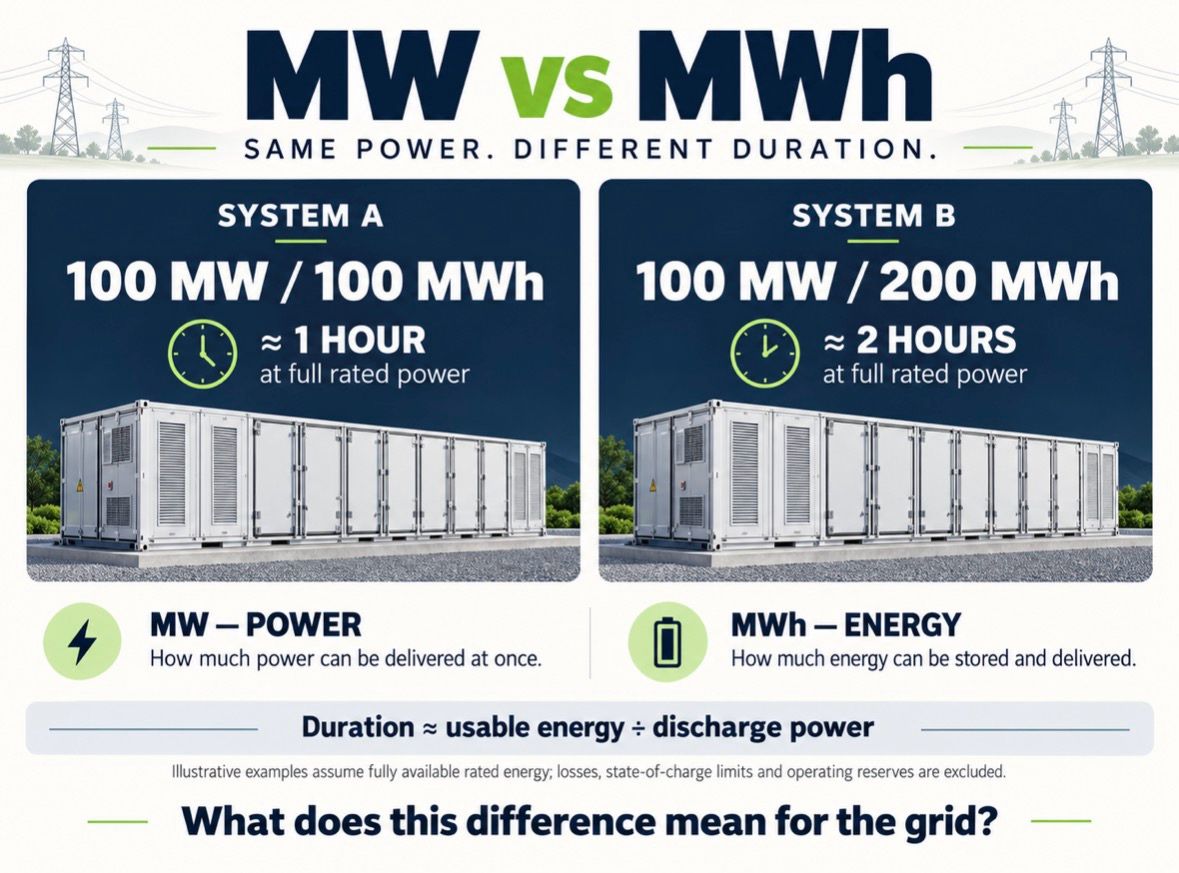
⚡ MW vs MWh: same power, different duration
100 MW / 100 MWh: approximately 1 hour at rated discharge power.
100 MW / 200 MWh: approximately 2 hours at rated discharge power.
Both deliver the same rated power; the second sustains it for twice as long.
Duration (h) ≈ usable energy (MWh) ÷ discharge power (MW).
These illustrative durations assume fully available rated energy and exclude conversion losses, operating reserves and other practical limits.
☀️ Why it matters for Uzbekistan
Solar output falls toward evening while demand can remain high. BESS can support:
Energy shifting from high-generation periods to evening peaks.
Peak shaving and net-load smoothing, easing demands on conventional generation.
Fast active-power response for frequency regulation.
Renewable integration by managing output variability.
⚙️ Beyond storage: Grid-Forming (GFM)
GFM inverters can establish and support voltage and frequency, rather than relying on an existing grid waveform as Grid-Following controls do.
Depending on design, available energy and controls, GFM BESS can provide:
Fast frequency response and synthetic inertia.
Voltage support and improved weak-grid stability.
Enhanced response during disturbances.
Potential black-start capability.
These services are not automatic. They require suitable specifications, dynamic stability studies and verification against grid connection requirements.
🔧 Choosing the right configuration
Engineering assessment must cover:
Charging/discharging power and usable energy.
Required duration, cycling profile and operating schedules.
Ramp rates, response time and state-of-charge limits.
Round-trip efficiency and degradation.
Grid-Following or Grid-Forming controls.
Connection requirements and system stability.
More MWh does not automatically mean higher power or faster response. GFM capability does not replace sufficient MW and MWh.
The key question is:
“How much power is needed, for how long, and which grid-support capabilities must the system provide?”
At UzEnergoEngineering, we believe renewable integration requires coordinated generation, storage and grid development—supported by technically sound, economically justified engineering.
We work with trusted local and international partners who share our commitment to quality, reliability, and innovation. Together, we deliver solutions that create real value for our clients.






Developed by the UZEE Information Technology Department
We on social media